

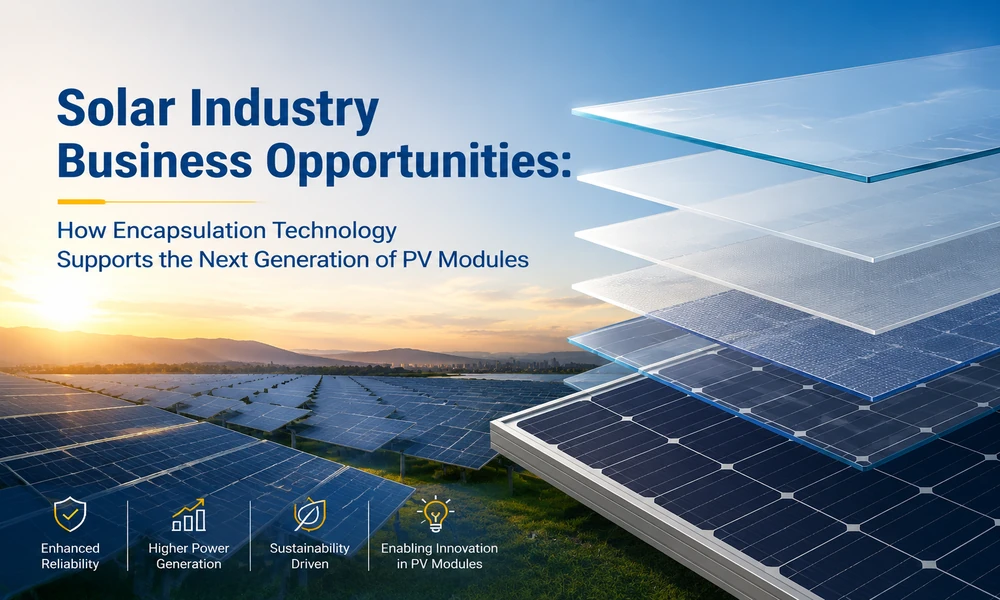
The global solar industry is entering a new phase driven by higher-efficiency photovoltaic (PV) technologies, diversified applications, and increasing expectations for long-term module reliability. While solar cells remain the center of attention in discussions about efficiency improvements, another critical component is quietly becoming a key competitive factor: PV encapsulation technology.
Encapsulation films protect solar cells from moisture, UV radiation, mechanical stress, and environmental degradation. As photovoltaic modules evolve from conventional PERC technology toward TOPCon, HJT, BC (Back Contact), and perovskite tandem technologies, encapsulation materials are no longer simply protective layers. They are becoming advanced functional materials that directly influence module lifetime, power output, and cost competitiveness.
For manufacturers, investors, and supply chain partners, this transformation creates significant solar industry business opportunities. Companies capable of developing high-performance encapsulation solutions will play an increasingly important role in the next generation of PV modules.
1. Growing Demand for High-Performance PV Modules Creates New Material Opportunities
The solar market is expanding rapidly, but future growth is not only about increasing installation volume. The industry is shifting toward higher-quality and more reliable PV systems.
Modern PV modules face increasingly demanding requirements:
- Higher conversion efficiency
- Longer operational lifetime
- Better resistance to harsh environments
- Lower degradation rates
- Compatibility with advanced cell technologies
As module manufacturers pursue higher efficiency, the vulnerability of photovoltaic cells also increases.
For example:
- TOPCon cells require stronger protection against UV-induced degradation (UVID) and potential-induced degradation (PID).
- HJT cells are sensitive to moisture and require excellent barrier properties.
- BC cells demand improved encapsulation solutions to protect complex rear-side structures.
- Perovskite tandem cells require advanced materials capable of maintaining stability under heat, humidity, and light exposure.
These challenges create growing demand for specialized PV encapsulation films such as:
- EVA solar encapsulation films
- POE encapsulation films
- EPE co-extruded films
- Advanced functional films for next-generation PV technologies
The encapsulation market is therefore evolving from a commodity business into a technology-driven sector.
2. From Traditional Protection to Functional Performance Enhancement
Historically, encapsulation films were mainly considered a protective layer between solar cells and external environments. However, future PV modules require encapsulation materials that actively contribute to performance improvement.
Advanced encapsulation technologies can provide multiple functions:
Enhanced UV Protection
Long-term UV exposure can accelerate material aging and reduce module power output.
New-generation encapsulation films are designed with optimized UV blocking capabilities to reduce ultraviolet damage while maintaining high optical transmission.
This is particularly important for:
- Desert solar farms
- High-altitude PV projects
- Tropical regions with strong solar radiation
By improving UV resistance, encapsulation materials help extend module lifetime and maintain higher energy yield.
Improved PID Resistance
Potential-induced degradation remains a major concern for large-scale PV projects.
High-voltage systems, humid environments, and sodium ion migration can accelerate PID-related power losses.
Advanced encapsulation materials with improved electrical insulation and moisture resistance can significantly reduce PID risks.
For module manufacturers, this creates an opportunity to differentiate products through higher reliability rather than competing only on cell efficiency.
Better Optical Performance
As solar cells become more efficient, every percentage of light utilization becomes valuable.
High-transparency encapsulation films help maximize light transmission into the solar cell, improving module power output.
For applications such as:
- Bifacial modules
- HJT modules
- BC modules
- Building-integrated photovoltaics (BIPV)
optical performance is becoming a key material selection factor.
3. The Shift from EVA Dominance to Multi-Technology Encapsulation Solutions
EVA has remained the dominant encapsulation material for decades because of its excellent balance between:
- Cost
- Process maturity
- Adhesion performance
- Manufacturing compatibility
However, emerging PV technologies are driving diversification.
EVA: Cost-Effective Solution for Mainstream Modules
EVA solar film continues to play an important role in large-scale PV manufacturing due to:
- Mature supply chains
- Reliable lamination performance
- Competitive pricing
For conventional modules, EVA remains one of the most commercially attractive solutions.
POE: Premium Protection for High-Efficiency Modules
POE offers superior moisture resistance and electrical insulation compared with traditional EVA.
It is increasingly used in:
- HJT modules
- Bifacial modules
- High-reliability applications
As manufacturers prioritize lower degradation rates, demand for POE solutions continues to increase.
EPE: Balancing Performance and Cost
EPE encapsulation film combines the advantages of EVA and POE.
Through a co-extrusion structure, EPE provides:
- Improved moisture resistance
- Better PID performance
- Reduced POE consumption
- Cost optimization
This makes EPE an attractive solution for manufacturers seeking high reliability without significantly increasing material costs.
The development of multiple encapsulation technologies creates new market opportunities for suppliers that can provide customized solutions.
4. Global Manufacturing Networks Become a Competitive Advantage
As PV production expands globally, supply chain flexibility is becoming increasingly important.
Solar module manufacturers are looking for suppliers that can provide:
- Stable production capacity
- Local technical support
- Fast delivery
- Regional supply security
Encapsulation film suppliers with global manufacturing networks have a strategic advantage.
A diversified production footprint helps customers:
- Reduce logistics risks
- Improve supply chain resilience
- Respond faster to regional market demands
For example, suppliers with manufacturing facilities across Asia, Europe, and emerging solar markets can better support international module manufacturers.
5. Emerging PV Technologies Will Accelerate Encapsulation Innovation
The next decade of solar development will bring new opportunities beyond traditional crystalline silicon modules.
Perovskite and Tandem Solar Modules
Perovskite tandem technology is considered one of the most promising future PV technologies because it can achieve higher efficiency than conventional silicon cells.
However, perovskite materials are highly sensitive to:
- Moisture
- Oxygen
- Thermal stress
- UV exposure
Advanced perovskite encapsulation solutions will be essential to commercialize these technologies.
This creates opportunities for material companies developing:
- Low-temperature lamination solutions
- High-barrier encapsulation films
- Advanced adhesive systems
- Functional protective layers
Conclusion
The future competition in the solar industry will not only depend on better cells but also on better materials that enable those cells to achieve their full potential.
Encapsulation technology is becoming a strategic growth area because it directly impacts:
As PV technologies continue to evolve, companies that invest in advanced encapsulation materials will gain new opportunities across the global solar value chain.
From EVA and POE optimization to EPE innovation and next-generation solutions for HJT, BC, and perovskite modules, encapsulation materials are becoming a critical foundation for the next generation of photovoltaic development.
For solar manufacturers and investors, the opportunity is clear: the future of PV is not only about making more efficient cells-it is about protecting and maximizing their performance throughout decades of operation.